
Posted on

Row your Boat – Local Regatta Trophies 1879-81

Yacht 1879 Colac Regatta Prize

A Row about Rowing!

This group of silverplate trophies are an interesting insight into the origin of Australian’s obsession with Sporting Events, which were used as a means of bringing the newly established colonial communities together and giving them a sense of ‘Pride of Place’ that is still very active today.

Australian Trophies

Moorabool recently discovered this trio of interesting local trophies, all won by a Mr R. D. Booth, Banks Club.

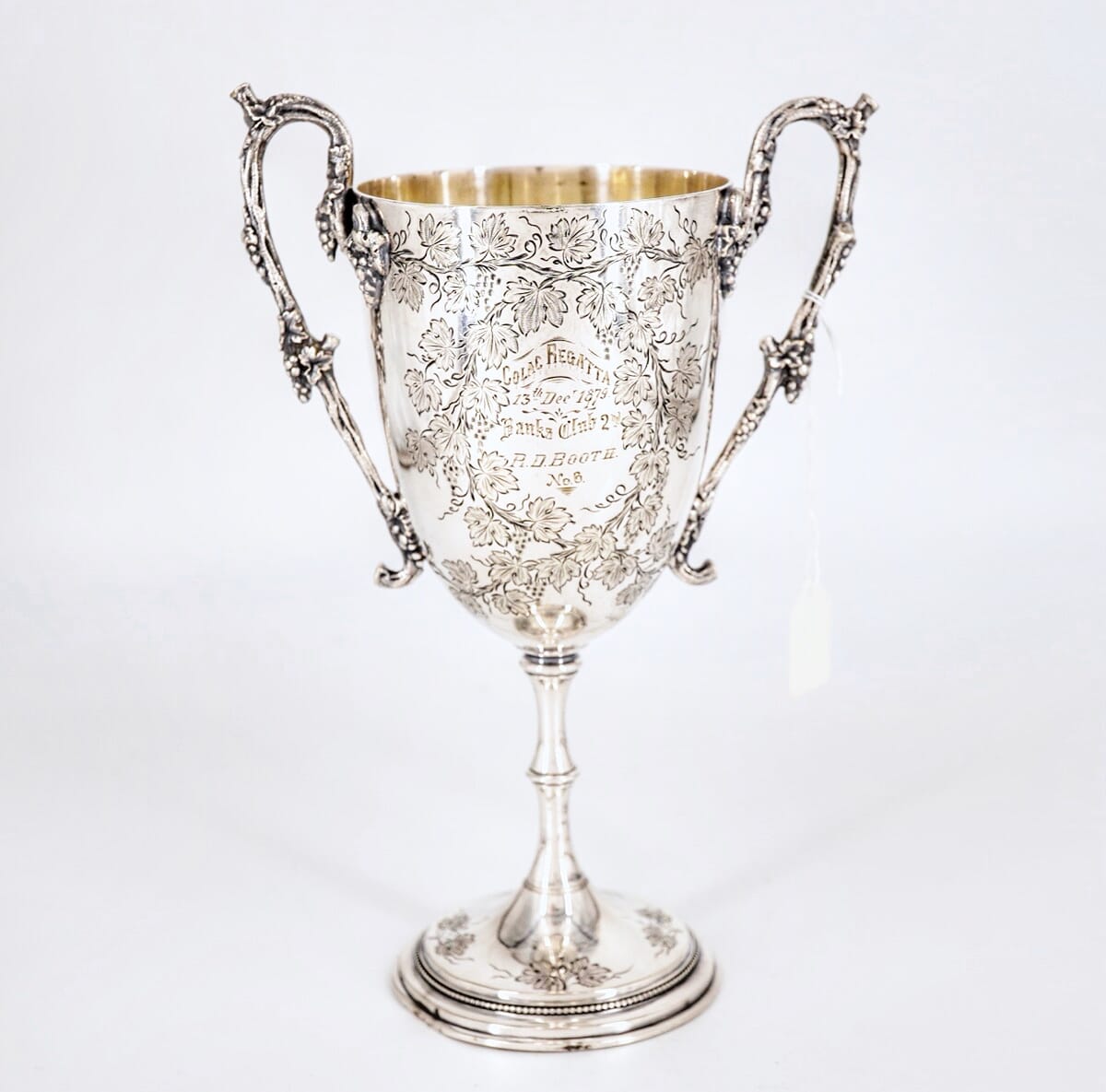
The first (on the right, above) is an elaborate fine-quality piece of English electroplate, engraved with fruiting vine & with handles dripping with grapes – a curious choice for the prize for the 1879 Colac Regatta. Most probably, it was simply a case of what was available in the English imports at the Melbourne jewler’s shops.

1879 was the first year that the event was held on Lake Colac, the largest inland lake in Australia. It required quite an effort to organize, with boats being transported overland from Ballarat, Geelong, and even Warrnambool to compete. The freshly laid Colac – Geelong railway connection allowed the logistics of transporting them such a long distance.

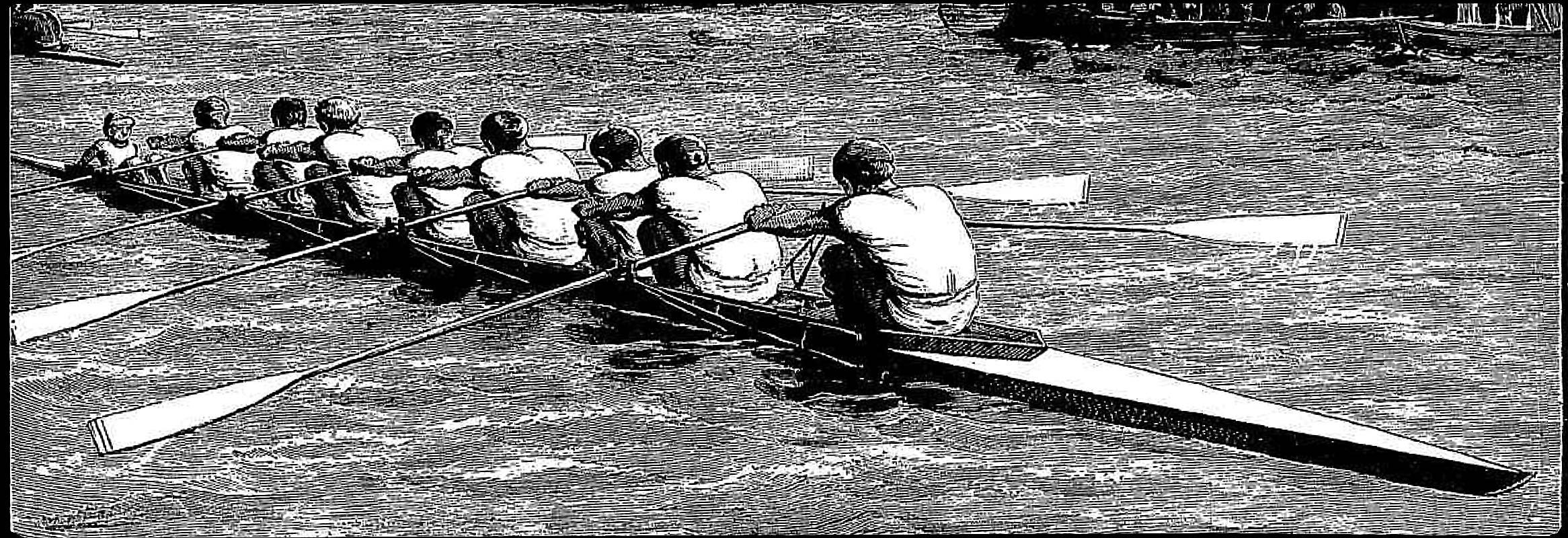
The Colac Regatta, 1879 – from the Australasian Sketcher, 1880

There had been an earlier ‘regatta’ on Lake Colac on March 29th, 1879; the newspaper reports on it wax lyrical, describing a crown of 2,500 people from Geelong, Ballarat, Melbourne, and everywhere in-between all having a jolly good time: the Colac Herald reports on April 1st 1879 the “flags of all nations were blowing”, and the sight of all the boats & flags “…brought to the recollection of many the youthful remembrances of bygone years.” – in other words, the gathering was a time of bonding by the settlers over memories of the ‘Old Country’, a nostalgic celebration of what was commonplace in Europe, but a first on this far-away picturesque Australian lake in the Western District of Victoria.

“Old and Infancy; the youth and beauty of Colac and district were there, all eager to witness the interesting excitement of aquatic contests”….

Colac Regatta 1879
A Colac Regatta of the 1880’s

“One or two slight mishaps occurred during the day which tended to amuse those present more than mar the proceedings, and were caused by the capsising (sic) of three boats…. “
One of these was the Maiden Sculling Race: ” only two started. At the start both men pulled away together, but the ripple of the water was too strong for the frail craft pulled by Parkinson, and the result was that he came to grief by the boat swamping when about half the distance had been pulled….. (he) swam to one of the posts and clung there until he was rescued by one of the boats of the Colac club.”

Yacht 1879 Colac Regatta Prize
A Yacht on the 1881 Melbourne Regatta Prize

Fine entertainment indeed! And it was this ‘ripple of water’ caused by ‘a strong breeze blowing incessantly during the day (meant) the water was rather too much ruffled for the rowing contest….”

The success of this regatta showed the potential for a regular event to be held on the lake, and also the inappropriate nature of the windy season at the start of the year; and so the committee decided to schedule one for the same year. This second event has gone down in history as the official ‘First Regatta’, held on December 13th.

Booth's 1879 Colac Regatta Prize
Booth’s 1879 Colac Regatta Prize

This event built on the experience of the first, and was a major event for the town. The Most Hon. George Augustus Constantine Phipps, Marquess of Normanby, GCB GCMG PC, in his role as the Governor of Victoria attended until the 8-oared race, after which the crowd cheered him to his special train which was to take him ‘back to town’ (Melbourne).
The Australasian covered the spectacle on December 20th, 1879:
“That an inland town so far removed from at least two of the principal boating centers should have attracted such numerous entries … speaks volumes for the exertions of the committee to provide first-class sport on their beautiful lake.”
The boats were again brought by train:
“Several first-class yachts were brought down by rail from the golden metropolis at considerable trouble and expense, while two eights (from Melbourne and Geelong) … made the eights the feature of the day”.

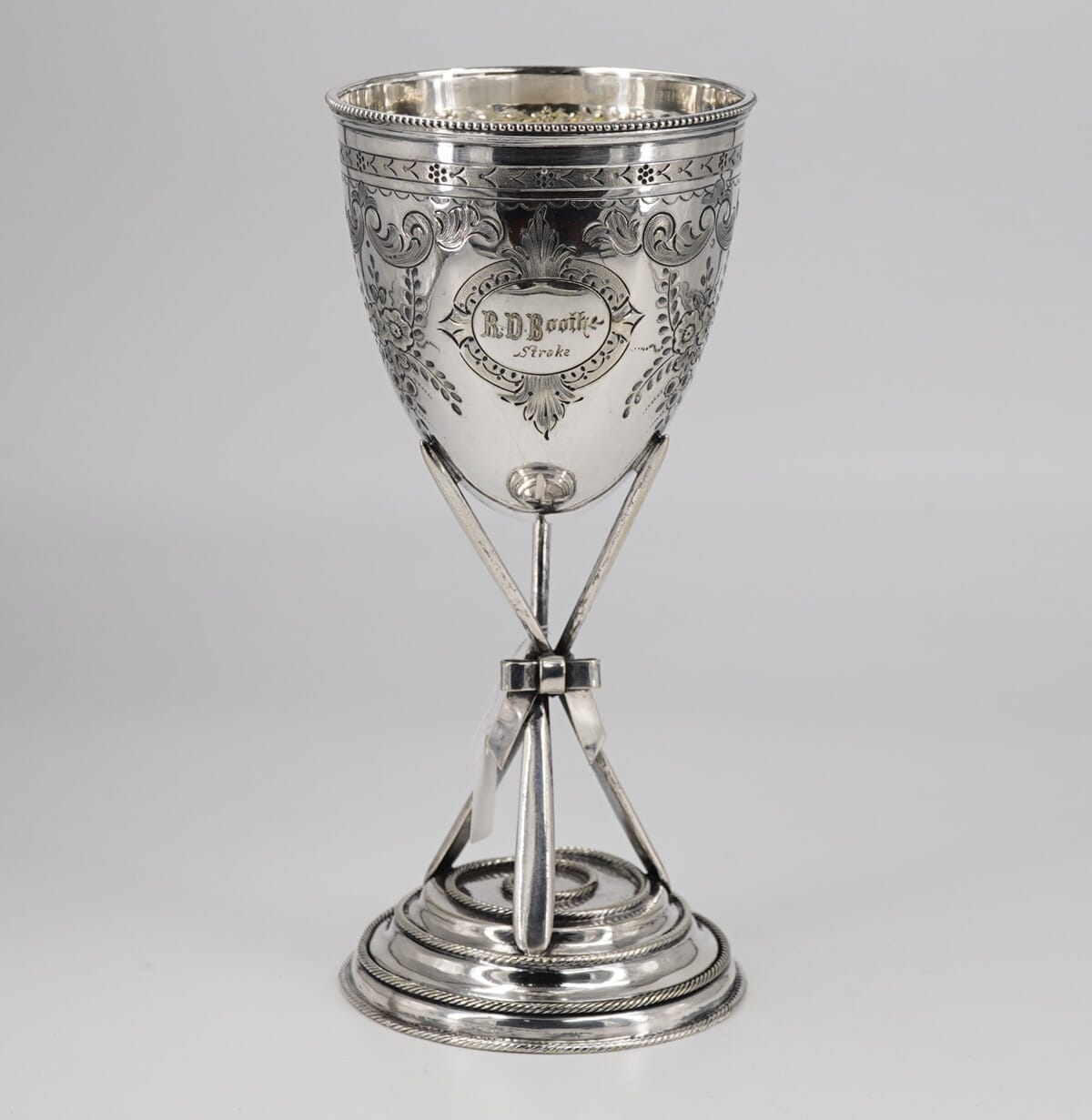
Our cup was a prize for this 8-oared race, and was awarded to the Banks Club as 2nd prize, this cup going to R.D.Booth, the no. 6 in the boat.

The ‘Banks’ club is a famous Melbourne rowing club, established very early, in 1866 on the ‘banks’ of the Yarra River in Melbourne – from where it still operates, producing many champion rowers for the present Australian sporting world. It is the ‘Banks’ club not because of the location, but due to the Bankers who were the founders: only Bankers were welcome to join, and the fees per annum were rather high – £1/1/ to join, then £2/2/ per year – a substantial amount in today’s money. But with secure bank-jobs, and the captain a manager, money wasn’t really a concern – unlike the working class Footscray crew, as we will explore later on in this article.

Booth's 1879 Colac Regatta Prize
Booth’s 1879 Colac Regatta Prize

In 1879, Banks Club packed their 8-oared clinker outrigger boat onto a Colac-bound train, and took on the teams of the Corio Bay Club (Geelong), Civil Service Rowing Club (Melbourne), the Ballarat Rowing Club , and the Barwon Rowing Club (Geelong). The prize total for this 8-oared, “about 2 mile” race was £105 – with first price being a decent £80. However, as only 5 entries were received (they were hoping for 8) this was reduced to £60 for first, £20 second and £5 third.
The crew of 8 and their cox were all ‘weighed in’, with R. Booth being on oar no. 6, as recorded on our cup. They made their way out onto the lake towards a start position, all five crews trying to line up in a pesky breeze with limited success – and when the question came from the small steamer bearing the race official “….Are you all ready?”, several replied no – but the whistle was blown, and those not ready scrambled to catch up; Banks careered into Ballarat in the scramble, nearly fouling them, and the others gradually pulled away towards their goal. Like the Olympic commentators of today, the reporter described the flow of the teams as they pull up, then drop back…. “Ballarat seemed overmatched from the jump, and were in addition badly steered…. after the first half mile the Banks and Corio forged ahead gradually, Barwon having retired from the foremost position…”
Then it all came unstuck for Banks:

When about half the course had been traversed, No 7 of the Banks caught a crab, and this accident, together with the advantage already possessed by Corio, enabled the latter to secure a lead of about a length, which was maintained the remainder of the journey, and Corio were proclaimed the winners by about a length.”

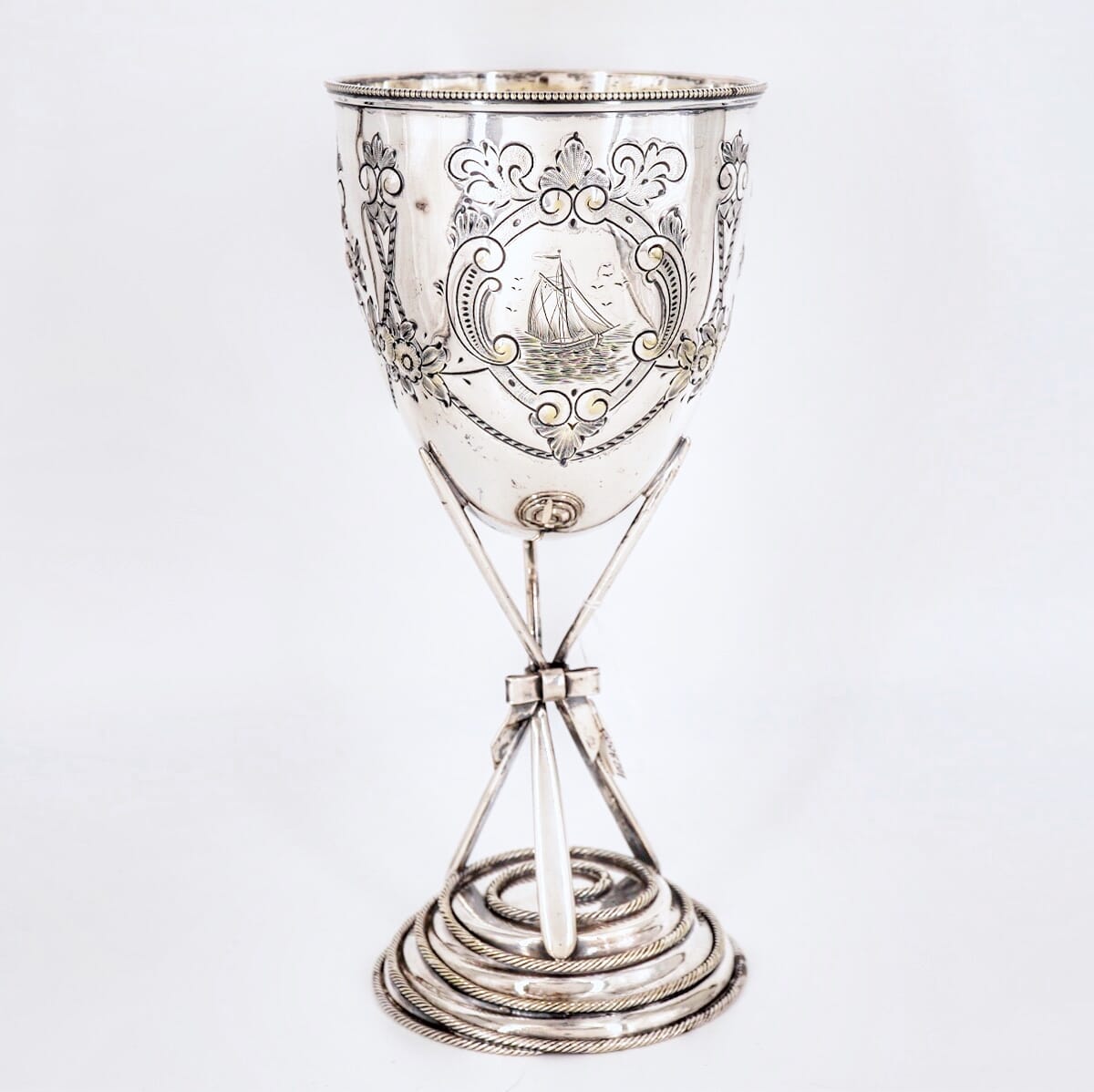
More suitable prizes for the occasion are the other two cups. These are splendid English silver plate examples, the base with coiled rope, the support modelled as three oars lashed together with a ribbon. These are marked ‘Lee & Wigfull Sheffield’, a manufacturer who specialised in sporting trophies, but only formed in 1879: these were brand-new designs from a freshly-formed English company.
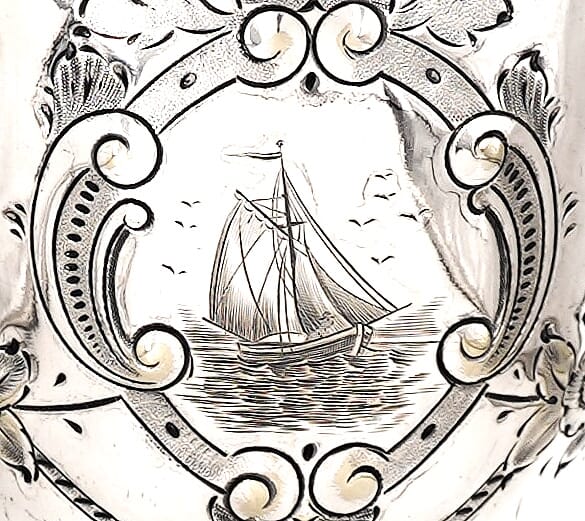
The cups are engraved with scrollwork framing panels to either side – one with a very nicely executed small sailboat. Once again, these were won by Booth as part of the eight oared race, and then the four oared – but this time on their home turf – in the Melbourne Regatta of 1881.

This event took place on the ‘Salt Water River’ – nowdays known as the Maribyrnong, flowing into the Yarra not far from its mouth. 7-8,000 spectators cheered them on, and The ‘Illustrated Australian News’ for 12th March 1881 carried the report along with an engraving of the winning moment for the Footscray crew, winning the Clarke Challenge Cup. This silver cup, valued at 100 guineas, was the most valuable race trophy in the world at the time, and is still held by the Footscray Club. It has two oarsmen perched on its shoulder, holding aloft their equipment on an angle – complimenting our trophies which would have sat alongside it, as prizes for the ‘Amateur’ races in 1881.

The Footscray crew dominated the race – as they had in their wins the previous 2 years – and this caused problems with the other teams, as these men were “…men who gained their living by manual labour”. This was seen as an unfair advantage, as the other teams didn’t, rather being ‘amateurs’ – ie most probably Clerks, or some other sort of desk-job. The issue raised was these ‘amateurs’ were unable to compete with “..those whose daily vocations are such that they may be said to be in training all year round.”! As a result, a definition of Amateur was arrived at, and applied to certain race classes,

1881 Melbourn Regatta - Banks Team wins

Our trophies relate to the footnote at the bottom of this article, “The Banks Club won the Junior Fours and Eights in excellent style,…”. And on our smaller example, the committee has chosen to make a point about the amateur vs workman debate by inscribing

Maiden Clinker –
Four Oared Race –
Bona Fide Amateurs …. Won by Banks Club

Robert D Booth was an interesting character who loved his rowing: he has been described as ‘one of the greatest oarsmen of his time’. He was a bank clerk with the Commercial Bank when he joined the Banks Club, during which time he won these three trophies. Soon after, he was a part of the Melbourne Club. He represented Victoria in the ‘Intercolonial’ events for may years, beginning with a win in 1878 against NSW . His list of placings is impressive, with barely a 2nd-place marring the list of first place prizes. In 1887, he was part of the crew who won the title for Victoria against NSW on Sydney harbour. An interview with the Sydney Morning Herald on May 30, 1887 gives us a fascinating insight into this true Australian sportsman:

Mr. Robert D Booth, stroke of the Victorian crew, is a clerk in the employ of the Union Mortgage and Agency Company, Victoria, and a broad-shouldered, sinewy young man, affording in his person a good argument that the pen is not necessarily incompatible with muscular development. Mr. Booth’s physiognomy is an infallible and open index to his temperament A subdued, unostentatious manner, it is impossible to dissociate from it determination and tenacity of purpose, resettled by the square-cut features and resolute chin. Mr Booth, interviewed by our representative, said that he all along expected a close race, and the opinion was not shaken by the brave appearance presented by the New South Wales crew on Saturday. As to the victory and details of the race, he so as reticent and becomingly modest, although Mr Booth allowed himself to say, in a moment of excusable enthusiasm,that he never doubted the result for a moment, in spite of the opinions expressed in the press…..

The interstate rivalry is extremely clear in the rest of the article, a classic press-bashing that would not be out of place on the back page of today’s average paper….. Sport has not changed a bit beneath the surface!

Melbourne Regatta 1881

Seen as an ‘entertainment’, these nautical Regatta events – along with horse races, athletic meets, and cycling, were in fact an important part of forming a sense of unity – through competition – amongst what was a large and diverse group of new arrivals to the region. The sense of pride conveyed in the various paper’s reports at the time show a healthy competition between the various regional cities, and between the States of Australia that certainly still flourishes. These trophies, as reminders of the origins of today’s rivalries, are important historical memories.
Posted on

A golden Japanese Zogan purse, c.1920

A Japanese Goldsmith’s Masterpiece

As the world watches the competition for Olympic Gold in Tokyo, we have a 100-year-old masterpieces of Japanese goldsmith’s work to share.

[metaslider id=91726 cssclass=””]

We were stunned when this small yet precious object walked into our shop recently. While we have had similar before, they inevitably are plain on the inside – often just with an empty space for cigarettes. This one is special: on opening, we see a place for a few of the required cigarettes – but inhabiting the other side is everything you need for an outing: this case is an all-in-one ‘evening bag’!

The mirror opens up to reveal a compartment with an ivory plaque, while below the small frieze of birds above is a surprise: two coin holders, such as the Victorians used for sovereigns and half-sovereigns.

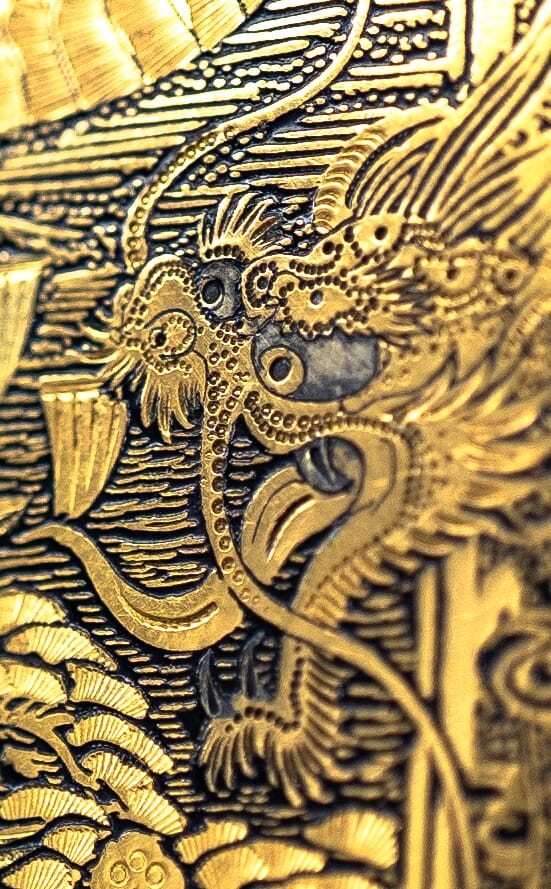
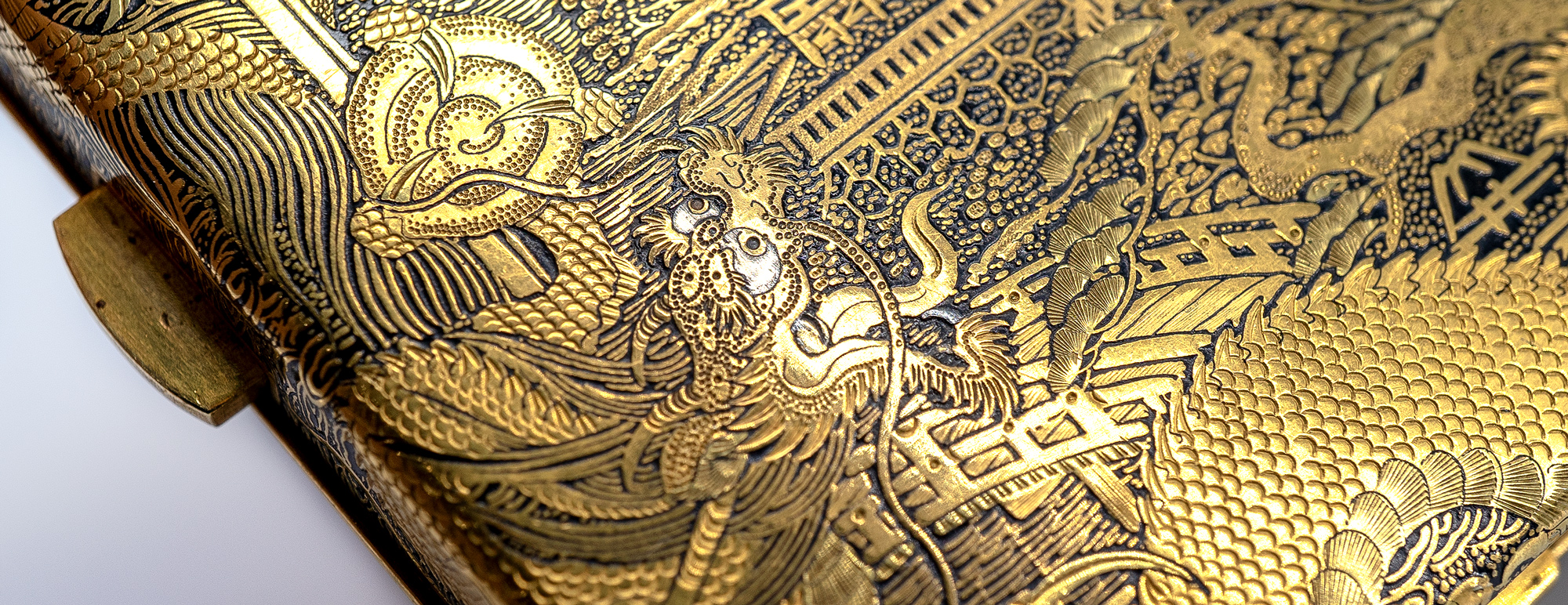
The work is intensely beautiful, with two tones of gold along with small silver details (dragon’s eyes) contrasting vividly against a patinated iron ground. We call this ‘Damascened’, as Damascus was a point from which the art spread in the centuries after the decline of the Roman Empire. It reached Japan by the Asuka Period (592-710), and ‘Nunome Zo-gan’ ( ‘symbolizing inlaying‘ ) is the Japanese word for the technique.

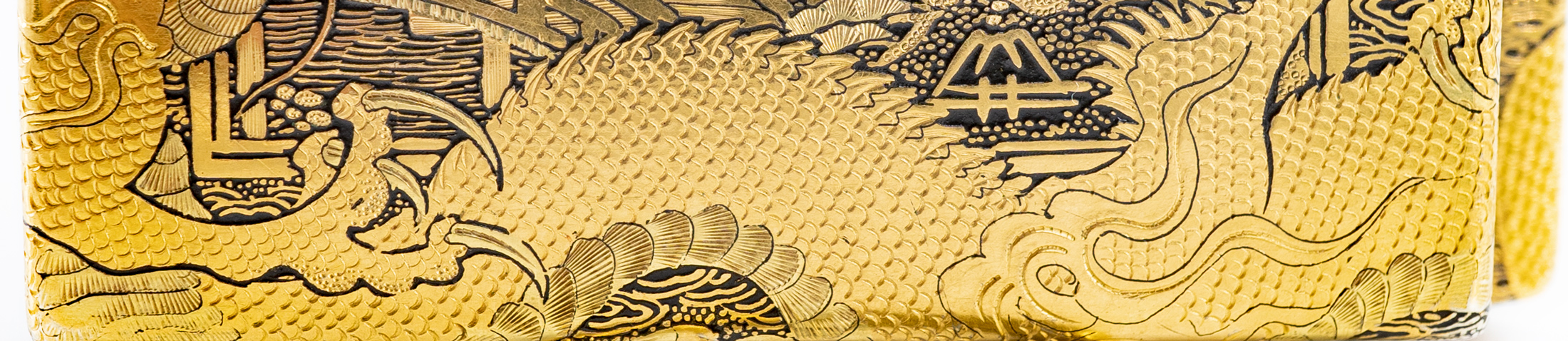
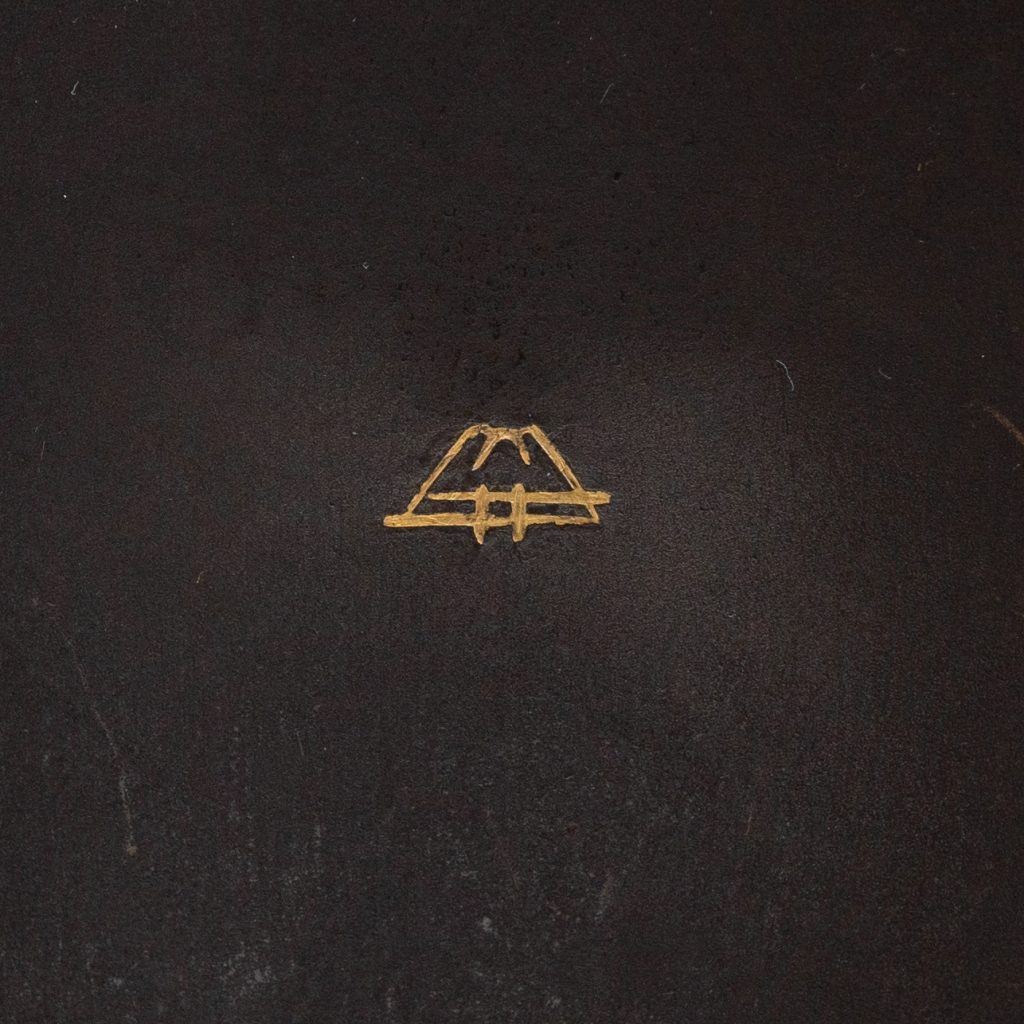
You may not have noticed the signature hidden in plain sight… the one inside is well isolated, being inlaid gold on a bare iron ground, and depicting Mt Fuji. This is the mark of the “Fuji Damascene Company”, operating 1912-26. The outside has a splendid view of Mt Fuji off in the distance behind the temple tower – but down in the foreground is this same signature, amongst the plants of the garden.

Yoshitoyo Fujii
The Fujii Damascene Co. Mark, c.1912-26

Mt Fuji was appropriate as the mark, as ‘Fujii’ is the name of the firm’s founder – Yoshitoyo Fujii. Born 1868 into a metal-crafters family, he developed the family business into a thriving international ‘luxury goods’ supplier. They produced brooches, cufflinks, necklaces, card cases, cigarette cases, writing sets, vases, table boxes…. a long list of superbly detailed items. Some of his works were selected to represent Japan in the numerous overseas exhibitions that were so popular of in the earlier 20th century, where he won numerous medals. His works were presented to the Japanese Royal Family – he was regarded as the best craftsman of the Damascene ‘Nunome Zogan’ technique. Ironically, his work is not pure to the ancient Zogan technique: he developed a new technique, for which he received a patent: an etching method of housing his inserts, suggesting an acid being used to get the fine lines needed, not just a chisel.

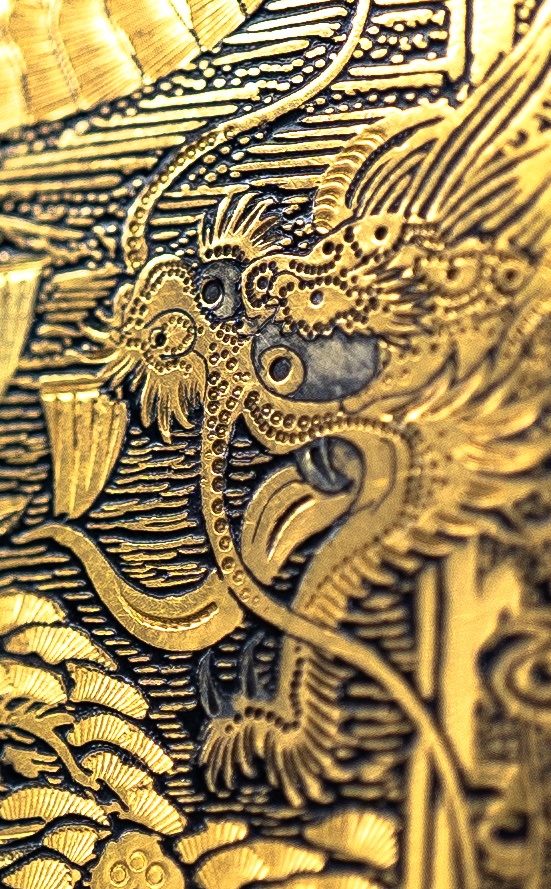
Superb Dragons by Fujii Yoshitoyo

The results are certainly spectacular, as these close-up photos reveal. This is a remarkably beautiful object to hold, and must have been a pleasure to use on a ‘night out’ by the lucky individual who received this as a gift 100 years ago: it certainly would have been a highlight at any party, back in the 1920’s!

Posted on

English Cottage Watercolours

A Victorian favorite
The Victorians loved the romance of the countryside. This was the period when the majority of people came to live in the ‘urban sprawl’ of the large cities like London, and the countryside became a distant place of idyllic beauty. Artists were constantly using this nostalgia for a flower-filled country life as their inspiration, and country cottage watercolours became best-sellers.
We have three nice works fresh in, including some colourful & well-priced works by William Affleck (1869-1943).

The very respected Birket Foster was in great demand, and the story is told of the race from the station to his studio by competing dealers when he had work to sell!
Such paintings were in great demand in the late 20th century, but have slumped since. Foster’s works have surpassed $200,000, with his larger works averaging $20-50,000. While a little sun-touched, our example is a well priced example of his work. Let the race begin…..

Posted on

Newly identified Derby Figure of Dr Syntax

‘Dr Syntax crosses a Lake’ , figure # G13

It’s always rewarding to discover something that has not been identified before. In the British Ceramics world, this is possible even in Australia….
This curious figure turned up in Melbourne recently, and is obviously a depiction of Dr Syntax, a creation of the British writer William Combe which led to a series of books describing his bumbling catastrophical travels.
They were illustrated by the contemporary illustrator Rowlandson, beginning in 1812 with ‘The Tour of Dr Syntax in Search of the Picturesque’.  From the illustrations in these books, the Derby factory created a series of humorous small-scale figures. Moorabool had one example a few years ago.
left: the figure in front of an illustration from an 1820’s Dr Syntax publication . –> see more

These are well documented by the late Bradbury in his definitive work ‘Derby Figures’. The problem is, some figures had not been recorded in Britain, and these are referred to in the publication as ‘Unknown to the Author’.
We’ve found two of these ‘Unknown’ figures in the past in Australia: could this be the third?
A look through the list finds items G11-24 are all Dr Syntax, and three are listed as ‘unknown to author’. Of these the only likely candidate is No. 13: ‘Dr Syntax Crossing a Lake’.
Looking at our figure, we believe it is a perfect candidate for the missing No. 13, as he steps off a rocky shore into a lake – apparently too distracted by the picturesque surroundings to notice!

Posted on

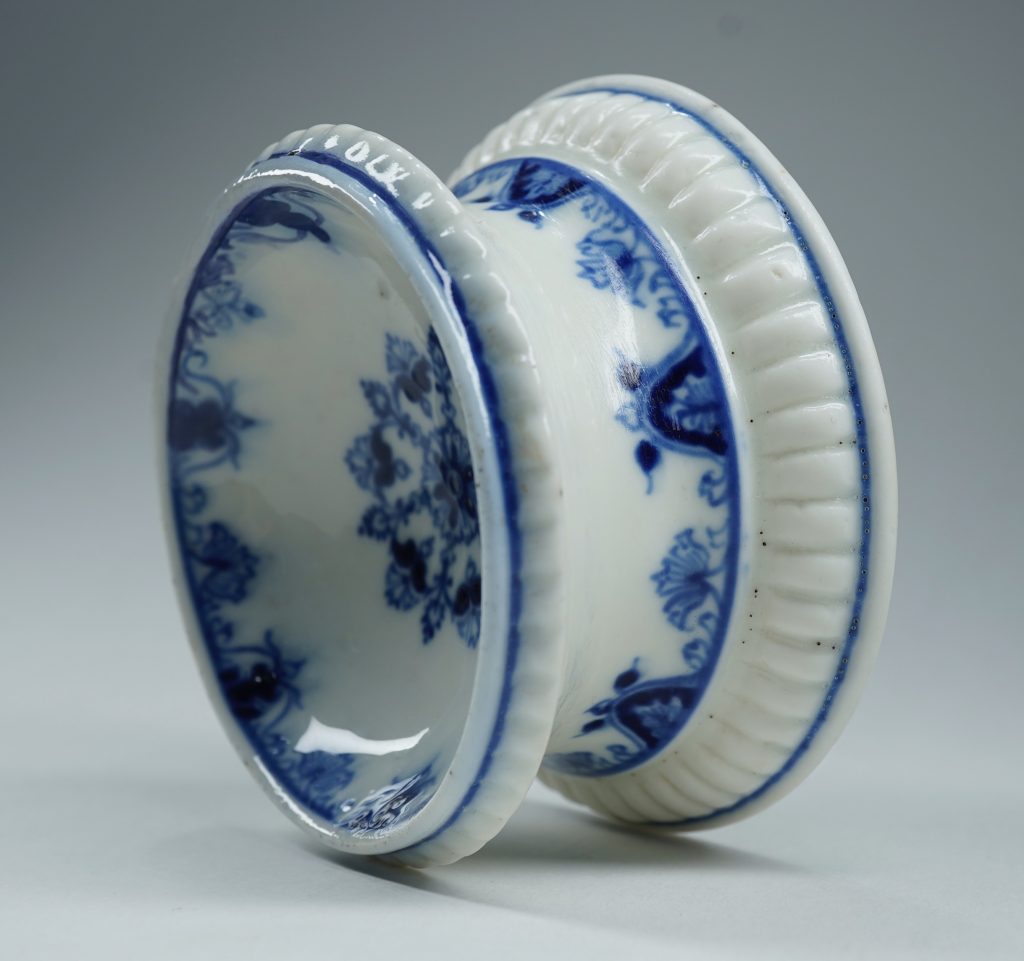
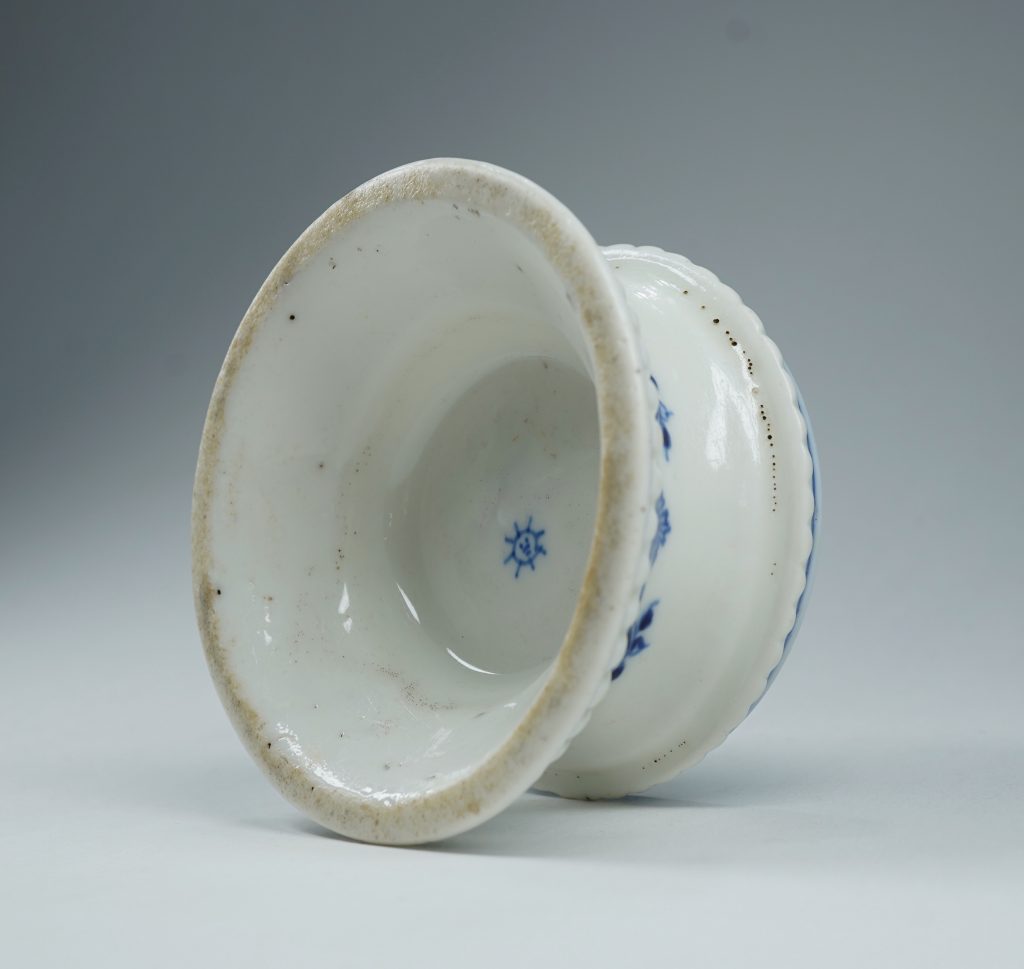
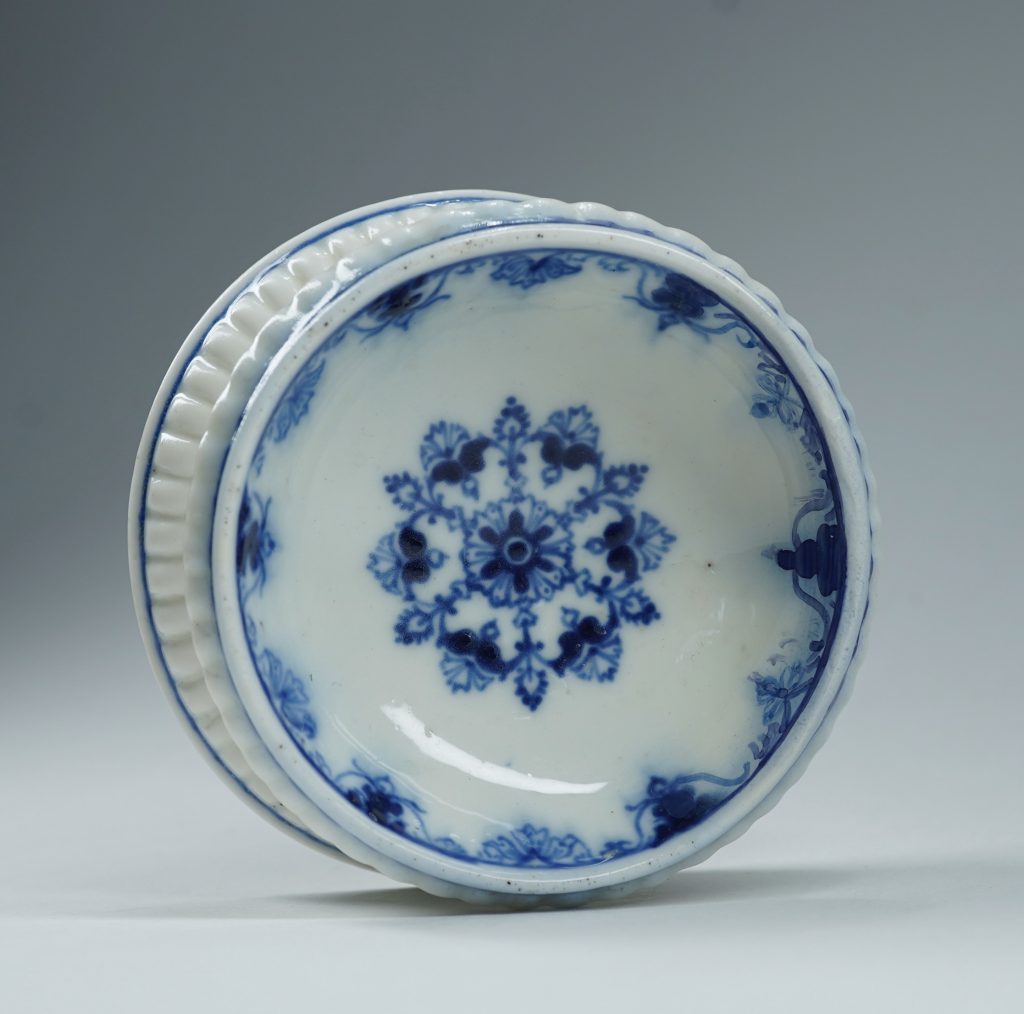
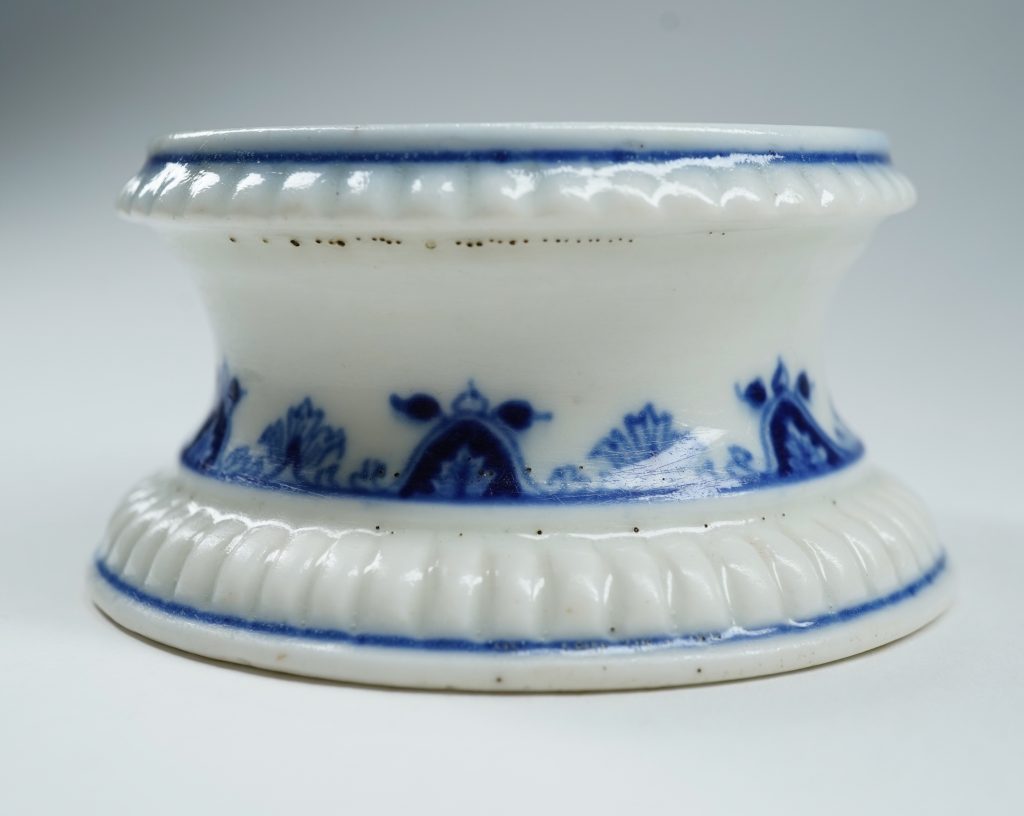
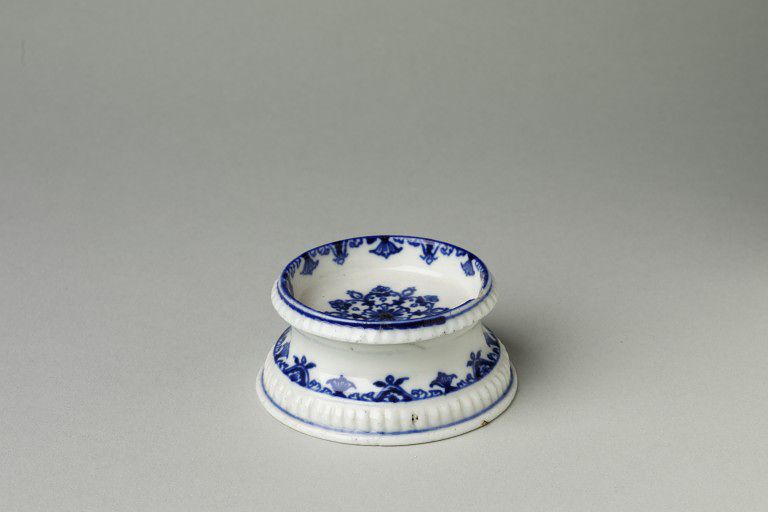
The Begining: a Saint Cloud salt, circa 1700

We are always fascinated by the origins of things…. when and where did it all begin?

In the porcelain world, it was of course China, around 1,000 years ago. This was so foreign and magical to the Europeans that pieces which made the perilous journey across the globe were only affordable by the most wealthy, being far more valuable than gold.

This all changed as the lure of such riches led to experimentation, and the first instance of a European porcelain body appears in the Medici courts in the 16th century, bankrolled by Francesco I; today, only 70 pieces have been identified, and the enterprise was a dead-end.

An example of Rouen Porcelain in the Sevres Museum.

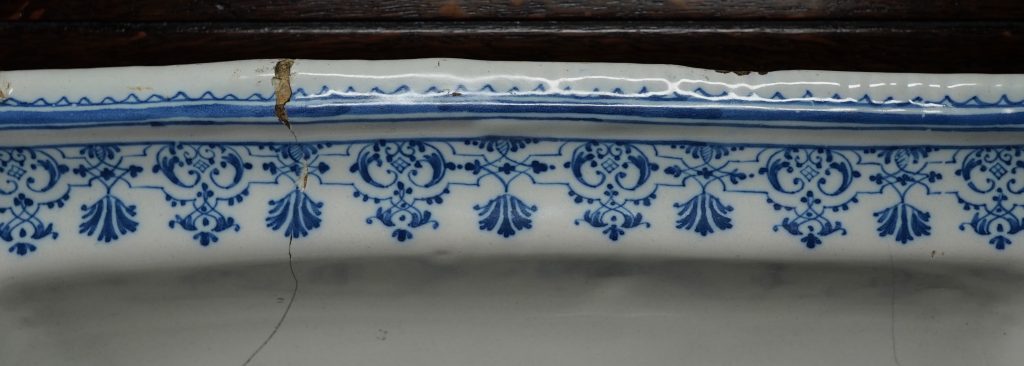
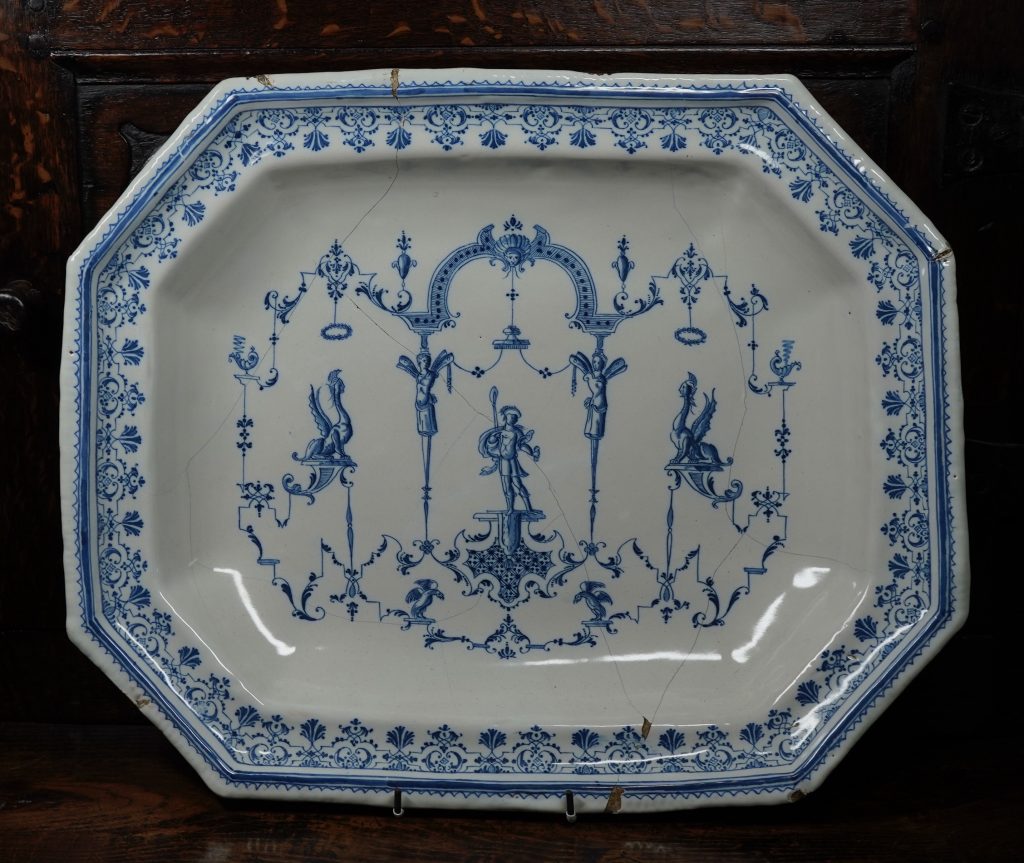
The next successful production appears in France. In Rouen, a pottery industry had for many years been producing Faience – earthenware pieces with a white tin-glaze, as an imitation of a white porcelain body. They developed a distinct design, known as a ‘Lambrequin’ – a border with repetitive symmetrical floral elements, borrowed from Baroque designs often seen in embroideries, metalworks, and related artistic products. In 1673, a privilege to make porcelain was granted to Louis Poterat, and he seems to have experimented without a viable production of commercial scale resulting – only a possible dozen Rouen porcelain pieces have ever been identified. A 1702 comment in the petition from the next factory mentioned described the Rouen effort at porcelain manufacturing as this:

“…..(they) did nothing more than approach the secret, and never brought it to the perfection these petitioners have acquired”.

-1703 Saint Cloud Royal Petition
A French Faience (tin-glazed earthenware) charger from the late 17th century, showing the distinct ‘Lambrequin’ borders seen on Saint Cloud porcelain products.
The designs are ‘le style de Berain’, taken from the 17th century designs of Berain, who was influenced by earlier Baroque designs which had borrowed heavily from Roman wall paintings!
This example in the Rosenberg Collection, Geelong, is probably Moustiers (Clerissy workshop), but is typical of the type made at Rouen during the period discussed.

The first commercially successful porcelain manufacturer is the factory at Saint Cloud.
This manufactury, like Rouen, began as a faience producer. A 1664 ‘Royal Privilege’ was given to a Parisian merchant named Claude Révérend, ‘..to produce faience and to imitate porcelain in the manner of the Indies (China) ‘ As a merchant, he was importing faience from Holland, and would have been very familiar with the superior Chinese porcelains.
He selected a manufacturing base, and in 1666 set out to make faience products – in the manner of Rouen – on the outskirts of Paris, at Saint-Cloud. Within a few months, Claude Révérend had passed ownership to his brother, Francois Révérend. He had actually lived for many years in Rouen, and it is no surprise that these first products of Saint Cloud faience are very close to Rouen products.

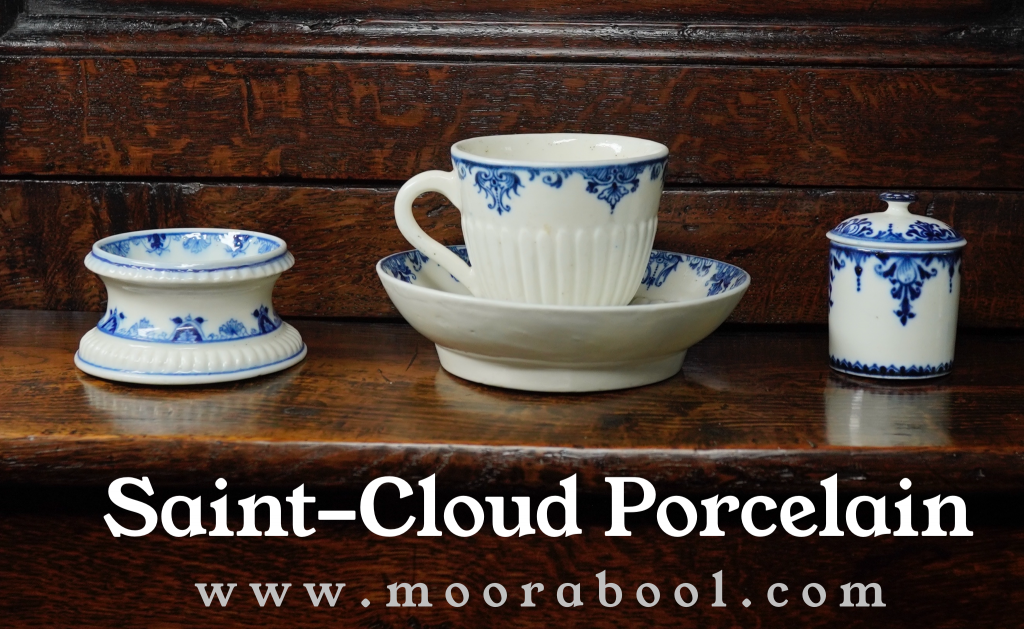
Three examples of Saint-Cloud porcelain currently in stock at Moorabool – links below.

An artist employed at this time to paint the tin-glazed faience wares named Pierre Chicaneau is the important character in the development of the first commercial porcelain production in Europe. He is possibly from Rouen, and George Savage speculated in his 1960 “Seventeenth and Eighteenth Century French Porcelain” that he may have been exposed to the porcelain experiments while there.
He begins at Saint Cloud in the 1660’s, and in 1674 he was made the firm’s director. He died in 1677, and it is the documents provided by his widow’s petition to the King for a Royal Privilege to make porcelain that gives us the full story of what was happening in Saint Cloud through the late 1660’s and early 1670’s; active pursuit of the secret of making porcelain.
His widow wrote in the 1700 petition

“Pierre Chicaneau, having applied himself for many years to the making of faience and having arrived at a very high level of perfection in this work, wanted to push his knowledge still further and find the secret of making true porcelain; for this purpose he undertook several experiments with different materials and tried different finishing techniques, which resulted in works that were almost as perfect as the porcelain of China and the Indes”

-1700 Saint Cloud Royal petition by the Chicaneau family

They go on to state the first success – a repeatable, commercial prospect that allowed manufacturing of the product – was achieved by the firm around 1693.
Dr Martin Lister, physician to Queen Anne in England and prolific writer, visited the works in 1698, writing;

“I saw the potterie of St Clou with which I was marvellously well pleased, for I confess I could not distinguish betwixt the pots made there and the finest China ware I ever saw. It will, I know, be easily granted me that the painting may be better designed and finished because our men are far better masters of that art than the Chineses; but the glazing came not the least behind theirs, not for whiteness, nor the smoothness for running without bubbles. Again, the inward substance and matter of the pots was, to me, the very same, hard and firm as marble, and the self same grain on this side vitrification. Farther, the transparency of the pots the very same.”


[yith_wc_productslider id=”80404″]

Examples of Saint Cloud in Moorabool’s current stock – click for more


Moorabool is pleased to offer a piece of this earliest commercial production from what can be seen as the first European Porcelain Manufacturer*.
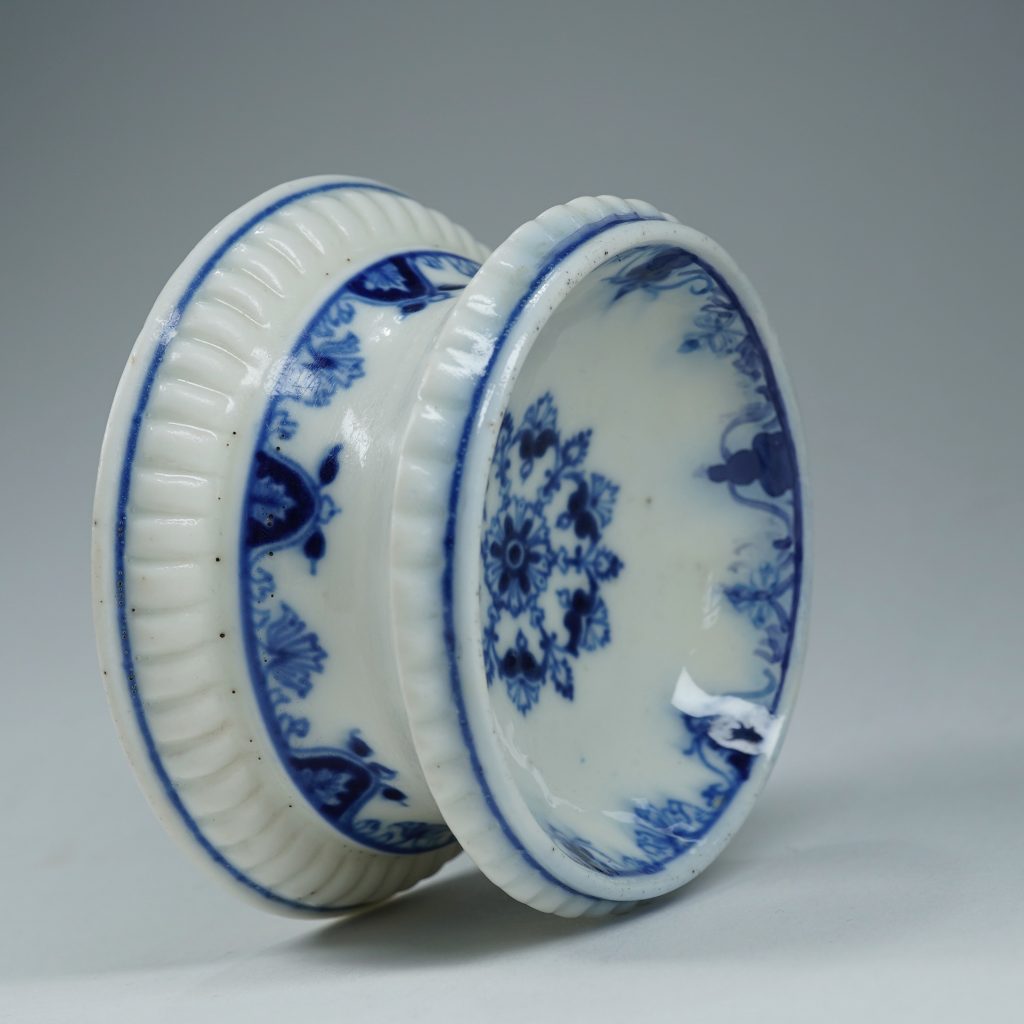
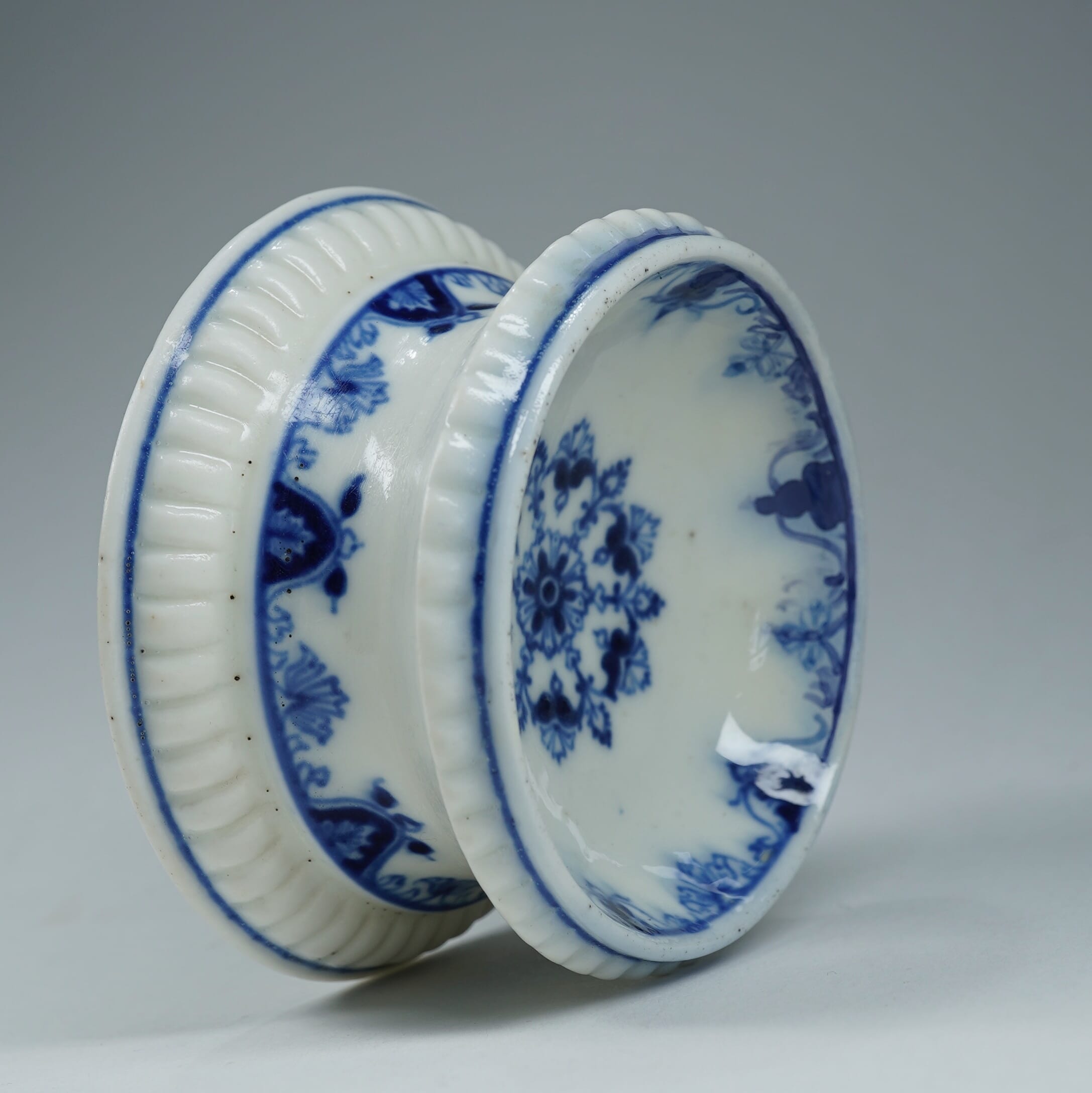
Our piece was a necessity on the elegant tables of the time, where salt was an important – and expensive – commodity that enhanced the dining experience. It was also a status symbol, as while the Crown imposed a tax on salt (la gabelle), exemption was made for the privileged Nobles and Clergy.

Several of these open salts would have been scattered down the table amongst diners. There are metal examples of the same form, and clearly the porcelain copies them.

Moustiers Faience Lambrequin border
Moustiers Faience Lambrequin border from the dish illustrated previously.

The decoration is classic Saint-Cloud, with a repeating pattern of lambrequin motifs in underglaze blue. Such decoration appears on the full range of Saint-Cloud shapes, such as cups & saucers, cosmetic jars, and even eggcups. Comparing the patterns on ours with other examples is fascinating, as it appears the artist was not faithful to any specific design – there are endless slight variations regarding the location of the various leaves, flowerheads, and the symmetrical tendrils that define them.

[metaslider id="80388"]

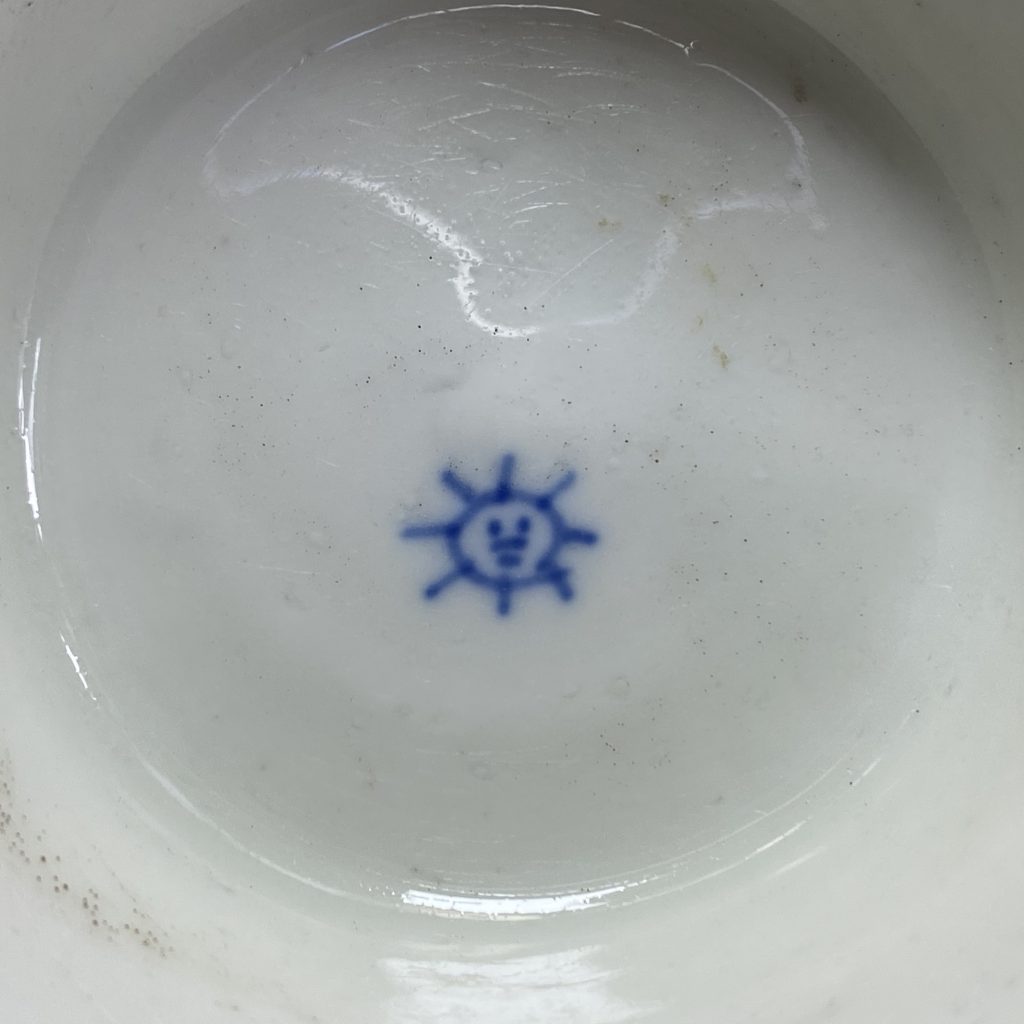
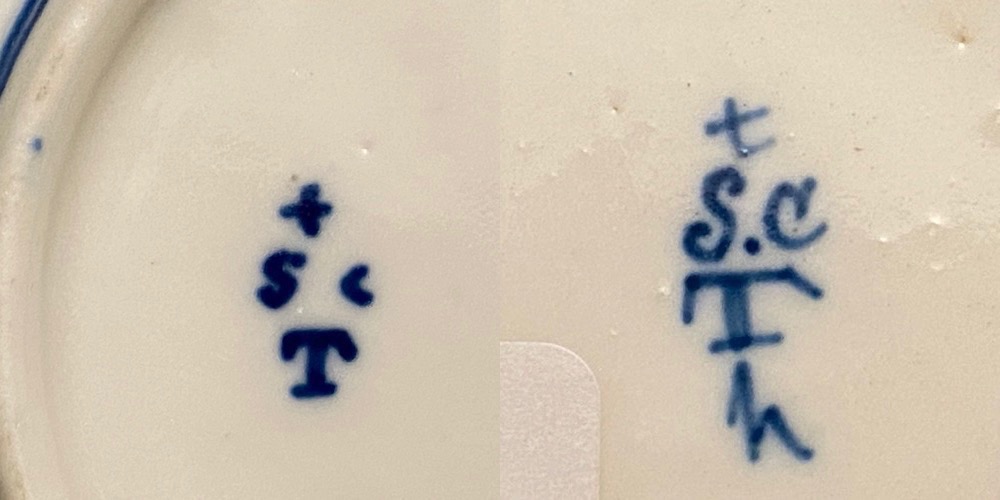
The ‘Sun’ mark is the earliest Saint-Cloud mark, and refers to the most important patron in France – Louis XIV, the ‘Sun King’. The factory location at Saint-Cloud was chosen because of the King’s younger brother, Duc d’Orleans, had an estate there, and became a patron of the fledgling factory. Louis XIV died in 1715, and the mark would most probably not have been used after that date; the more usual ‘St C’ begins during the second decade of the 18th century, and is identifiable as being post- 1722 by the addition of a ‘T’ beneath, indicating the change of Director to Henri Trou in that year. They continued making similar porcelain wares throughout the 1730’s-40’s, and finally closed in 1766.

Saint Cloud Sun Mark circa 1700
Saint Cloud ‘Sun King’ mark on our salt, 1693-1722.
The standard Saint-Cloud mark, including the ‘T’ for Trou.
The second example (Rosenberg Collection, Geelong) has an extra ‘h’, a painter’s mark.
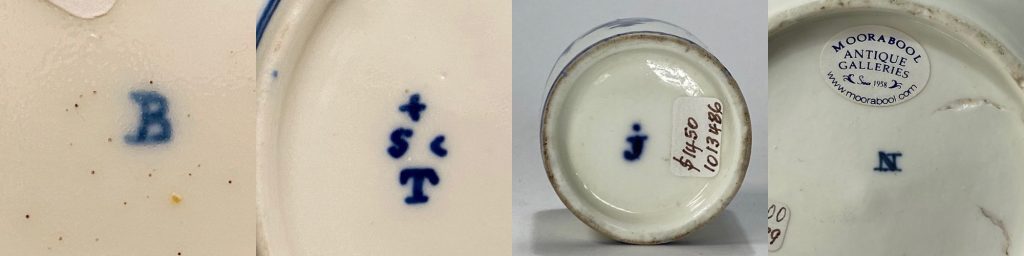
Not all Saint Cloud pieces are marked – and some have ‘painters marks’, usually an alphabet letter. This selection in Moorabool stock, or in the Rosenberg Collection.

Other examples can be seen various museum collections around the globe;
the Musée des Arts Décoratifs in Paris has 5 examples, of which 2 have the ‘Sun’ mark and are dated 1697-1700, while the other three are unmarked and catalogued “Saint Cloud or Paris”, post-1700 (reflecting the other porcelain manufactories in Paris who copied Saint Cloud in the early 18th century). In 1997, the collection catalogue (Christine Lahaussois) suggests a date of 1697-1700. In 1999, the catalogue for a NY exhibition (“Discovering the Secrets of Soft-Paste Porcelain at The Saint-Cloud Manufactory”, editor Bertrand Rondot) illustrates three of the same examples as definite Saint-Cloud, and dates them all post-1700, with the closest to our example (including a Sun mark) being 1700-1715.

An example with the same ‘Sun’ mark, similar decoration, can be seen in the British Museum, dated 1700-1710
https://www.britishmuseum.org/collection/object/H_Franks-330

An example in the Victoria & Albert, London, is very similar, with the ‘Sun’ mark, dated conservatively 1693-1724.
http://collections.vam.ac.uk/item/O307789/salt-cellar-saint-cloud-porcelain/
(It even has a chip to the rim – although unlike our example, un-restored!)

An example on display in the V&A, # C.474-1909

Sources & Further Reading:

George Savage “Seventeenth and Eighteenth Century French Porcelain” 1960

Bertrand Rondot (editor) “Discovering the Secrets of Soft-Paste Porcelain at The Saint-Cloud Manufactory” 1999

Aileen Dawson “French Porcelain -a catalogue of the British Museum Collection” 1994

Christine Lahaussois “Porcelaines de Saint-Cloud, La collection du Musee des Arts Décoratifs” 1997

*I should note; when I use the term ‘Porcelain’ in this article, it is best described as ‘Artificial Porcelain’, meaning it was not the same as the Chinese products, as it lacked one of the main ‘stiffening’ ingredients. This is commonly called ‘Soft-Paste’, and defined the earliest French and English products.
True Porcelain, in the Chinese manner, was produced by the Chinese from around the Song Dynasty (900 AD), and in Europe, the experiments at Dresden (and subsequent production at Meissen) were by chance identical in their basic ingredients, and this product is known as ‘Hard Paste’.

There is also a ‘Soft-Paste’ twist, with some fascinating experimental products appearing in England in the latter 17th century, possibly pre-dating the French efforts. John Dwight of Fulham was awarded a patent for porcelain in 1671, and may well have been successful – but not commercially!

Posted on

Porcelain Fraud, 1850 style: Worcester ‘Dresden Wreath’ pattern.

Who’s been naughty here?

Bowers PorcelainA part Victorian tea service in today’s Fresh Stock has an interesting tale to tell.
A glance at the mark suggests two possibilities: ‘Dresden’, ie made in the German city famous for the Meissen works, and ‘Worcester’. It’s neither!
The printed mark is typical of Staffordshire makers in the mid 19th century, and describes the pattern; a wreath of flowers in the Dresden style. They often had their name directly below such a mark, and indeed here we see 293 ‘Worcester’ written here.
But something’s not right: this is unlike any Worcester products, being printed and painted in quite a loose manner, and on porcelain which isn’t the usual pristine Worcester bone china…. closer investigation reveals a very interesting feature: the ‘Worcester’ is hand-painted over a printed name! Careful study reveals ‘G. F. Bowers & Co’ to be the carefully concealed maker’s name. 
George Frederick Bowers & Co. were a Staffordshire porcelain maker from 1842-68, a perfect date for this type of teawares & decoration. But how did ‘Worcester’ come to blot out their name? It seems unlikely that Bowers workers would do such a thing as the name was an important part of advertising, allowing a household to order replacements from the right firm. This appears to be a case of Porcelain Fraud: as Worcester was well-known and expensive, the logic conclusion is that a retailer has added the mark fraudulently in order to pass it off to an unsuspecting customer as ‘Worcester’!

Posted on

John Rosenberg, 1938-2020

John Rosenberg at the last AAADA Fair in Melbourne (2018)
John Rosenberg with his first ‘Antique’ – a Staffordshire spill, purchased around 1950!

With sadness we note the passing of John Rosenberg, founder of Moorabool Antiques, after a short illness on Friday 19th June.

He went to his first auction aged 7, with his Grandmother. This was at ‘Kerleys Auctions’, Geelong;
Aged 80, he was still buying, and went along to Kerley’s last-ever Auction before they closed down early 2020. This was also to be his last auction, as the sudden appearance of cancer took his strength.

We’ll have much more to share on this in the near future; if you have any memories of John (which we could share, anonymously) please feel free to email them to Paul.

A regular feature at our Antique Fairs!

He was dearly loved by many, a thorough gentleman of the old-school type, and passionate his whole lifetime about his chosen profession, Antiques. This passion radiated from him, and was catching to those fortunate enough to spend time in conversation with him!

Gone, but never forgotten…

Posted on

April 2020.

What a month….. we’re sorry to have been ‘away’ for the past 6 weeks, and no doubt the ‘C’-crisis is a glaringly obvious reason, as the world is paralysed by the hidden menace of the virus pandemic.

But the real reason is the other ‘C’: Cancer. John Rosenberg, founder of the firm back in the 1950’s, was taken to Hospital quite unwell in late March, and cancer was found. He has undergone major surgery – the result is that the doctors were satisfied they got it all. This is a great relief to us all.

Needless to say, this ensured our attention was no longer on our ‘Fresh Stock’ updates – and the timing with the required shop closure due to covid-19 was remarkable.
John is now back home and is recovering well – but is of course itching to get back to the shop!

John recovering back at home this week.

We have just instigated our ‘Recovery’ plan, representing both our post-Covid and John’s new reality, both of which require ‘social distancing’….. so we now have an Appointments booking service on our website.
When you are thinking of visiting Moorabool, simply pop into our web page and with a few clicks you can find a time, weekdays 10-4, plus a few hours on a Saturday. This will allow us to comply with the strict requirements for businesses to stay social-distancing aware.
John also has his own appointment page, with a Wednesday afternoon time-slot for anyone who would like to catch up. He’ll be up in the Lorraine Rosenberg Reference Library, a great place to experience his passion for ceramics…. so many tales to tell!

…where’s the Fresh Stock ?

Our ‘Fresh Stock Tuesdays’ were constant weekly tasks for the past 6 years…. and while we are most certainly not ceasing the release of fresh stock, it’s time for a change to this method. We will shortly have ‘Something Fresh’ to share….

A young John Rosenberg, back in the 1950’s when he joined the Dealers Association.

We were of course heading into our 2020 Fair time, to open May 1st in the Malvern Town Hall. This is postponed until the same time next year, but was to be a special occasion for Moorabool: a young John Rosenberg joined the Victorian Antique Dealers Association (now the AAADA) in 1958, the year they held their first Fair in the Malvern Town Hall. It had been born the previous year, and young John was asked to join by a local ‘founding member’. He was able to exhibit in the 1959 Malvern Fair for the first time – and continued to do so for the next 59 years straight!
2019 would have been the 60th Melbourne Dealers Fair Moorabool had exhibited in, but was cancelled. This year, 2020, was then to be the 60th….. now we look forward to making 2021 that milestone!

The late Lorraine Rosenberg, pictured at the Dealers Fair in the Malvern Town Hall, some time in the 1960’s.

We had great plans…. our stand was going to ‘pop’, with a unique design celebrating 60 years, and some stunning Fresh pieces sourced just for the occasion. Instead, these will be released as part of our ‘SOMETHING FRESH’ over the next few months.

We hope you’re all keeping well, and that our website has been a source of consolation in these peculiar times….


Best wishes & stay safe,
from Paul Rosenberg, John Rosenberg,
& all @ Moorabool….
…. still very much in business !

We’ll leave you with a ‘Fresh’ photo-
this is a wonderfully wild ‘ShiShi’ , the Japanese version of the the Chinese Buddhist lion-dog, or ‘Foo’ dog. He’s a censor, his head lifting off to take the incense – with the smoke coming out his mouth, nostrils, ears, and between the spines down his back!
Meiji period, earlier 19th century.
Coming to Moorabool stock shortly!

Shi Shi
A Japanese porcelain ‘ShiShi’ censor, Meiji period, earlier 19th century – coming soon!
Posted on

Take Care out there….

In light of the current situation gripping the World…. Moorabool is closing our physical shopfront and concentrating on this website.

Moorabool wishes all customers the best of health, and please take care out there.
We are still functioning behind the scenes, manning our website, and our postal system will continue, although naturally not as quick as usual.
If you are buying/selling, we are available by email, facetime, or telephone; our website is monitored, so please feel free to continue on as ‘usual’ as possible in this rapidly changing world….

As soon as we are ‘free’ of this invisible menace, we will have some exciting events to promote – having used all this down-time to prepare!

Sincere best wishes, from John Rosenberg, Paul Rosenberg, Alard Pett, Lindsay Wilson, and all @ Moorabool Antiques, Geelong.

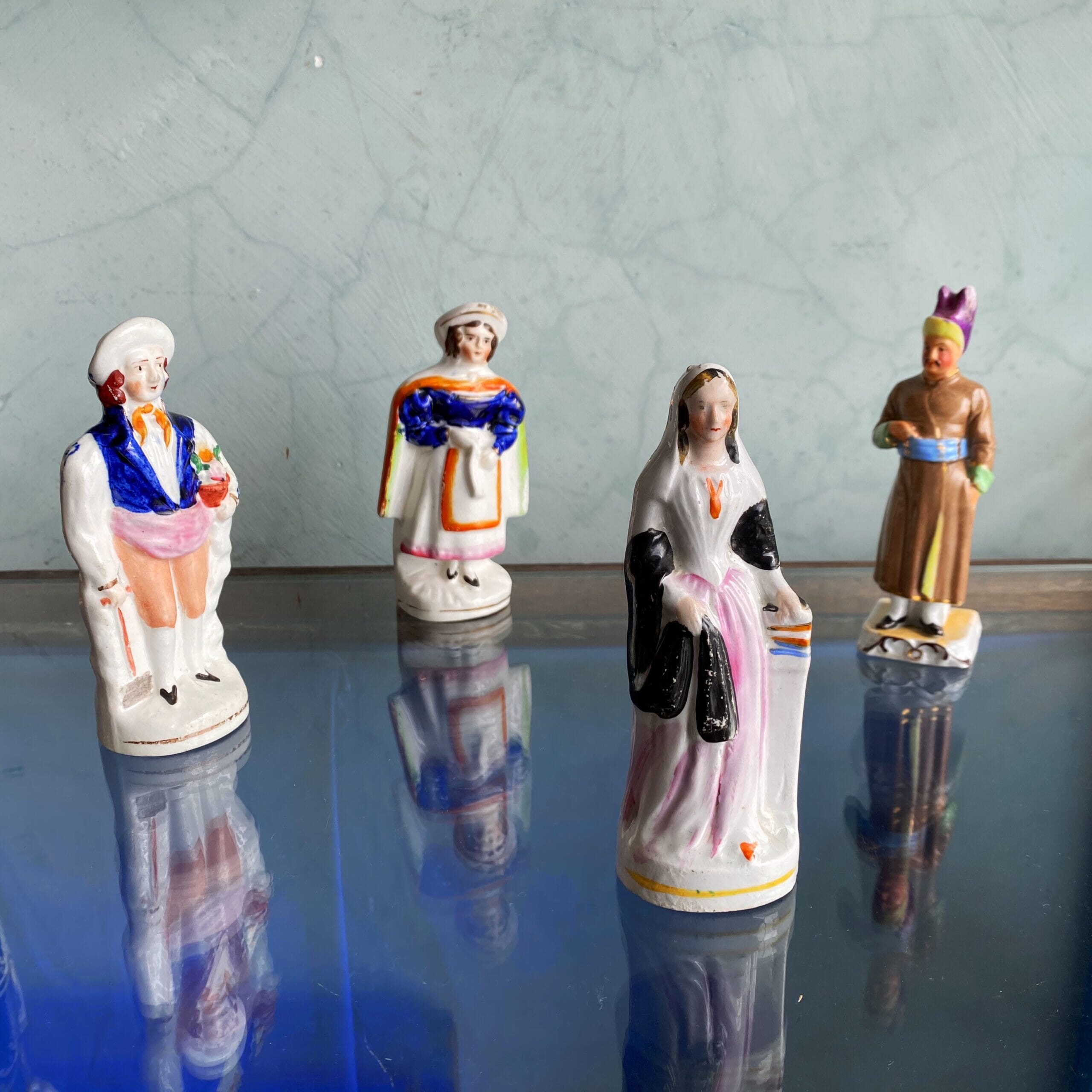
Florence Nightingale & friends
Staffordshire figures of the 1860’s including Florence Nightingale (and a German porcelain Turk!)

Illustrated here is Florence Nightingale & friends practicing ‘Social Distancing’ …. She was of course responsible (in the 1850’s) for the very first idea of how to contain a disease as it spread…. she would approve whole-heartedly of the incredible response our Governments are undertaking to tackle this age-defining catastrophe that is currently unfolding….

Posted on

A Vienna ‘Harvester’ Re-united

Moorabool is often a place of meeting, both for people who enjoy Antiques – and for the Antiques themselves! We have occasionally been guilty of ‘match-making’ in the Antique world, discovering pieces that were quite literally made to be together…. but somehow became separated. It’s a thrill to re-unite pieces.

Ready for the harvest…..?

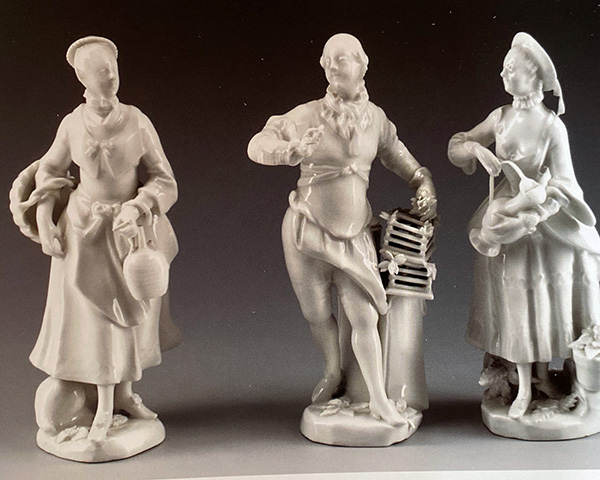
In today’s ‘Premium Fresh’ there is a rather sweet Vienna figure of a lady. Very early, she is circa 1755, and her costume is very distinct – very well dressed – and yet she carries a sickle and bundle of wheat. There’s more wheat behind her waiting to be cut; clearly she is a ‘Harvester’ off to sickle the wheat crop – but take a look at her shoes! How would they be practical in the fields…?

Vienna figure c.1755
Fresh to Moorabool’s stock
Vienna ‘Lady with Squirrel’ c.1755

While today we tend to place these lovely pieces in cabinets or a mantel shelf, in the 1750’s in Europe they were intended for the table. A scene would be set up along the length of a grand table, to entertain the guests with depictions of the gods, the Greek myths, a hunt, or in the case of a group of one group of interesting Vienna figures, “Pastoral Pursuits’.

The definitive book on these early figures helps us understand their purpose. ‘Ceremonies Feasts Costumes : Viennese Porcelain Figures during the reign of Maria Theresia’ is a splendid 2007 publication with large clear illustrations, detailing hundreds of Vienna figures from the 1740’s until the 1780’s. A private businessman, Du Paquier, had started the porcelain works in Vienna as early as 1719 ( making it the second true porcelain manufacturer in Europe, after Meissen), but by 1744 he was financially struggling, and the Viennese State purchased the works. This was of course ruled by Maria Theresia, the Empress of Austria, and she loved a good party… the porcelain works were an excellent source of the needed table wares, and this included table figures.

Vienna ‘Pastoral Pursuits’ figures, 1755-60

We find a series of well-dressed ladies & gents going about various occupations such as picking grapes, making wine, collecting milk…. and our lovely lady harvesting wheat. They’re an example of the idealisation and romantic notion that prevailed in the courts of 18th century Europe that the peasant lifestyle was an idyllic, carefree one. France of course excelled in this – think Mary Antionette and her role-playing as a milkmaid – and other courts tended to follow the fashions of France. Dinner parties could have an ‘Arcadian’ theme, meaning everyone would be dressed as a ‘commoner’ of some sort, but in silk and satin instead of the rough cotton the authentic garb would have been made of! These fancy-dress banquets had a curious way of dispersing the guests along the table – a lottery game would decide – giving the evening a sparkle of uncertainty in what was otherwise a very formalised environment.

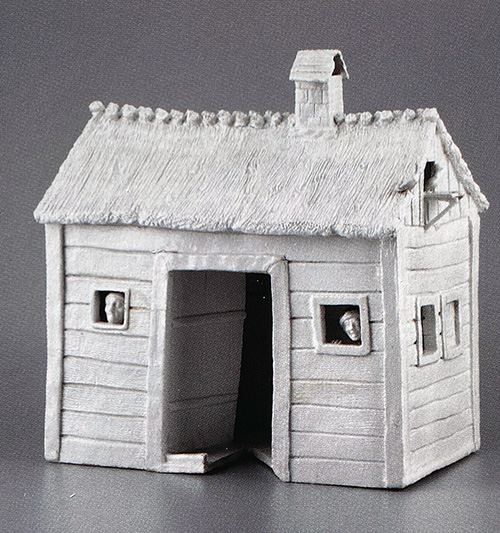
A Vienna Porcelain ‘Shepherd’s House’, circa 1755

Some rare survivors are model buildings for a table setting – also recorded in parallel in Meissen productions – suggesting the appearance of the table, with this banquet’s theme being Wirtschaft, meaning ‘Economy’ or ‘Workplace’ . This is the perfect fit for our lovely lady with the sickle. She’s actually a Princess, pretending to be a Harvester for the evening…..!

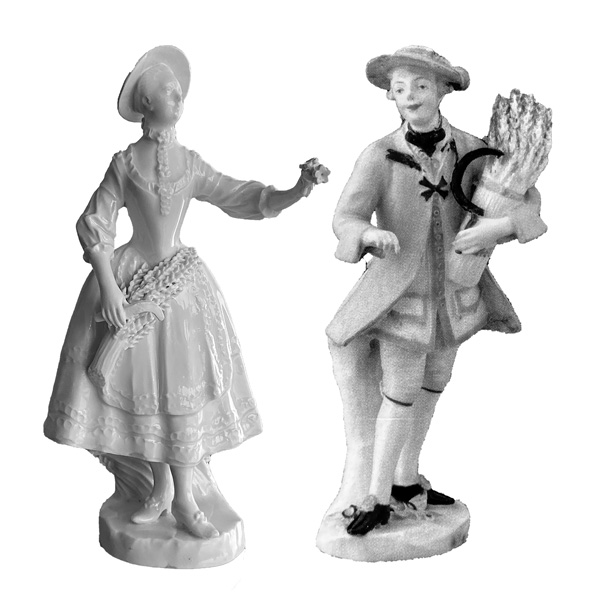
While exploring this fascinating topic, I came across a colourful ‘Cavalier as reaper’ group illustrated in the before mentioned book. Our lovely lass isn’t illustrated, but a comparison with the ‘Cavalier’ figure leads us to an exciting conclusion: this is surely a long-lost partner figure.

Introducing…. Vienna ‘Cavalier & Companion as Reapers’ , circa 1755

Moorabool Antiques 2020

Together at last… virtually, thanks to Photoshop!

Reunion…. the figure on the left is Vienna, circa 1755-60, in stock at Moorabool.
To the right is a ‘Harvester’ circa 1755-60, illustrated in ‘Ceremonies Feasts Costumes : Viennese Porcelain Figures during the reign of Maria Theresia’ (Appendix #2) from the Umeleckoprumyslové Museum, Prague {86.269} .
The two share numerous similarities, including size, decorative ’embroidery’ moulding to the clothing – and even the same shoes! – the only difference being the Prague figure is painted, the Moorabool left white. Their complementing poses and similar detailing lead us to propose they were originally conceived as a pair.